
Sustainable Energy Authority of Ireland (SEAI) has announced a significant package of improvements to home energy upgrade grants for 2026. Much of the early attention has understandably focused on the increased grant amounts. However, beyond the headline figures, there are important changes around eligibility, evidence, and performance that are worth understanding before homeowners begin planning works.
This article looks at how the new grants work in practice, and how homeowners can position themselves to get the best outcome from them.
What has changed and when
On the 3rd of February 2026, grants for attic and cavity wall insulation increased, making these already cost-effective upgrades even more attractive as early measures. Support for heat pump systems also rises significantly. The total heat pump grant can now reach up to €12,500, made up of:
- the heat pump grant itself
- a €2,000 contribution toward central heating upgrades
- and a €4,000 renewable heat bonus, increased from previous levels
From the 4th of March 2026, new grants for windows and external doors come into effect, along with additional supports for first-time buyers and households in receipt of qualifying social protection payments.
At the same time, SEAI has introduced greater flexibility under the One Stop Shop route where a heat pump is included. In particular:
- the previous requirement to achieve a 100 kWh/m²/yr energy uplift has been removed
- the requirement for a pre-works BER of B3 or worse no longer applies in the same way
These changes are intended to make upgrades more accessible, while still supporting well-planned and coordinated retrofit projects.
A stronger focus on whole-house performance
A clear theme running through the 2026 grants is a stronger emphasis on overall building performance, rather than assessing individual upgrades in isolation. This is now especially relevant for windows and doors grants, where eligibility is linked to how the dwelling performs as a whole.
As a result, the BER advisory report is becoming increasingly important. Beyond listing recommended measures, it helps homeowners understand how each major building element is classified and how these elements interact to influence overall heat loss.
Energy efficiency bands explained, “Good” & ” Very Good”

The table above shows how individual building elements are classified from Very Poor through to Very Good based on their U-values, alongside the Heat Loss Indicator (HLI), which reflects the overall heat loss of the dwelling. From the table, you can see that the dwelling itself is considered to have a Good level of heat loss once the HLI falls below 2.3. Similarly, roofs move into the Good category once their U-value is below approximately 0.31 W/m²K, while walls are classified as Good once they are below around 0.46 W/m²K.
In practice, a typical modern pumped cavity wall can often achieve a U-value below 0.35 W/m²K, which would comfortably place it within the Good category. However, this is not always reflected in the advisory report, and this is where the use of default values becomes important.
When good work still looks only “fair”
One important caveat is the use of default values in BER assessments. For older dwellings, particularly early cavity wall construction before 1978, conservative default U-values must be applied where documentation is not available.
This approach is necessary and protects consistency under audit. However, it can result in upgraded elements appearing as Fair rather than Good, even where the quality of work is high. In many cases, this comes down to supporting evidence, such as confirmation of cavity width or insulation type, rather than the upgrade itself.
This is why early advice and documentation matter.
Why the Heat Loss Indicator now matters more
Up until now, the Heat Loss Indicator was most closely associated with heat pump eligibility. Under the 2026 grants, its relevance is broader.
As grants increasingly focus on whole-house performance, the HLI provides a clear way of understanding how walls, roofs, and ventilation combine to influence overall heat loss. Addressing these fabric elements first strengthens the advisory report and supports later upgrades, including windows and doors.
Understanding your advisory report for the windows and doors grant
Since the announcement of the windows and doors grant, there has been a noticeable increase by homeowners in the advisory report, mainly trying to understand if their advisory report means they can apply for the windows and doors grant.
The current SEAI guidance highlights two key requirements:
- After the upgrade, the home must achieve a ‘Good’ or ‘Very Good’ Heat Loss Indicator (HLI) on the BER.
- Homeowners should check whether attic and wall insulation are already classified as Good or Very Good, as these elements have a major influence on overall heat loss.
Many homes already meet this standard. The challenge is knowing where to find this information in the advisory report.
Where to look first
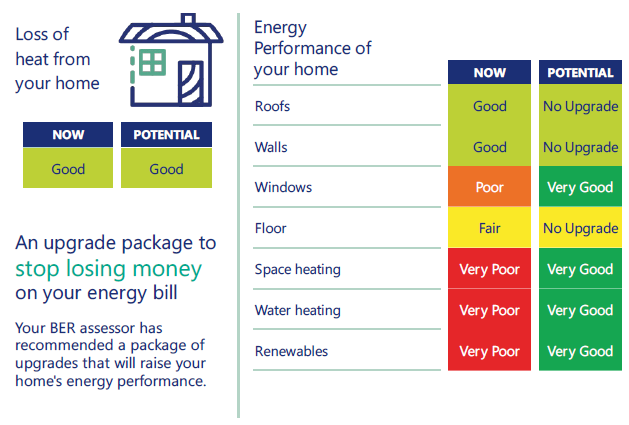
The energy performance summary breaks the home down into its main elements. In this example:
- Roofs are classified as Good
- Walls are classified as Good
- Windows are classified as Poor
- The overall loss of heat from the home is shown as Good
Roofs and walls are the critical elements for windows and doors grant eligibility. When both are already performing well, the home is often well positioned to meet the overall heat loss requirement.
The “loss of heat from your home” graphic links directly to the Heat Loss Indicator, which is shown numerically later in the report.
Confirming eligibility using the Heat Loss Indicator
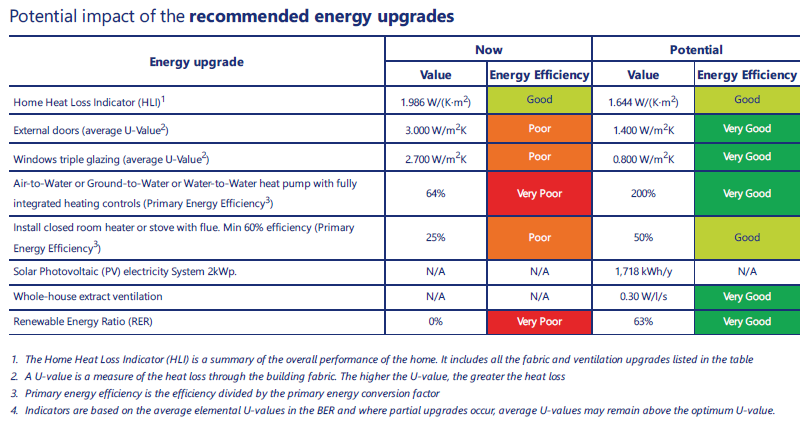
Further down the advisory report, the Potential impact of the recommended energy upgrades table shows the Heat Loss Indicator value itself. In this example, the HLI is 1.986 W/K·m², which is classified as Good.
This indicates that the home already meets the Heat Loss Indicator requirement for the windows and doors grant, subject to a post-works BER being completed after the upgrade.
In cases where a home is close to the Good threshold of 2.3, it may also achieve the required HLI once new windows are installed, as modern windows typically have significantly better U-values than older units. Where this is marginal, it is best confirmed in advance by the BER assessor by modelling the proposed window U-value and solar transmittance before works proceed.
Why supporting documentation matters more under the new grants
As the grants evolve, evidence is becoming just as important as the physical works themselves. In most cases, grant eligibility is influenced mainly by what can be verified within the BER methodology.
This is why SEAI often recommend pre- and post-works Building Energy Ratings, particularly for larger or staged upgrades. From a homeowner’s perspective, these provide reassurance that the proposed upgrades are appropriate, the expected performance improvements are achievable, and the grant requirements are likely to be met before committing to significant works. This also means that supporting information may be needed earlier in the process, for example confirming the U-values of proposed windows or doors in advance, rather than assumed values until certification is received later.
A positive step forward
Overall, the 2026 SEAI grant changes are a positive development. Higher grant values, broader eligibility, and greater flexibility mean more homeowners can take meaningful steps toward warmer, healthier, and more energy-efficient homes.
The key message is simple, early advice and good information matter more than ever. Understanding how advisory reports, defaults, and the Heat Loss Indicator work can make the difference between a smooth upgrade process and unnecessary delays.
With the right guidance at the outset, these grants can work exactly as intended, delivering better homes and better long-term outcomes.
Does anyone grant cover insulation of external walls. Cavity blocks used throughout.
As the owner of a 50 year old house that I have striven to upgrade, completly at my own expense- in fact paying tax on all the work, I find this scheme very disappointing. I am retired and cannot afford all the work that would be required to get my house into the HLI zone for grants.
Even where some upgrades have been done, I wont have documents to put into a spreadsheet and will therefore be penalised with default values.
It seems strange that someone with decent 15 year old doors can get a grant to upgrade them but someone with draughty 50 year old ones cannot.
Great article John!
Hi John,
Fantastic break down of the advisory report for the client. This is key to people understanding why it makes sense to upgrade.