
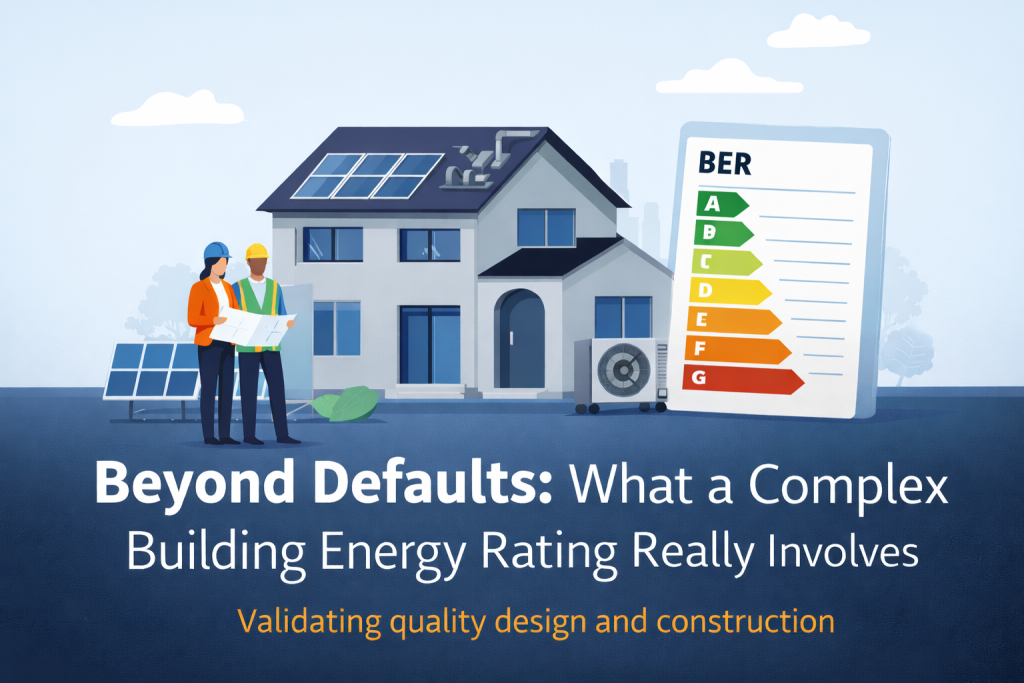
Not all Building Energy Ratings are the same. Some dwellings can be assessed using predominantly default inputs, while others require a far more detailed, evidence-led approach. The difference between a non-complex BER and a complex, non-default BER usually comes down to the building’s history, the extent of renovation, and the level of technical detail required to accurately reflect how the dwelling actually performs.
A Building Energy Rating is ultimately based on the annual energy demand of the dwelling divided by the total floor area. When that floor area changes, or when the fabric and systems of the dwelling are significantly altered, the assessment changes fundamentally.
Before looking at a real example, it is useful to outline what typically distinguishes a non-complex BER from a complex one.
Non-Complex vs Complex Building Energy Ratings
In simple terms, domestic Building Energy Ratings generally fall into two broad categories.
Non-complex Building Energy Ratings typically apply to dwellings such as:
- Standard bungalows
- Standard semi-detached or terraced houses
- Simple, rectangular two-storey houses or dormers
- Small, older but straightforward dwellings
- Homes with limited upgrades such as attic insulation, pumped cavity walls, or solar PV
These assessments usually involve:
- Predominantly default inputs
- Low documentation requirements
- Predictable survey and modelling effort
- Simple building form and standard heating systems
Complex Building Energy Ratings apply where a dwelling has undergone significant alteration or has inherent complexity, such as:
- Large or complex-shaped detached houses
- Dwellings with multiple or irregular extensions
- Homes with additional storeys added
- Recently renovated dwellings requiring non-default inputs
- Properties with heat pumps, mechanical ventilation, or other complex systems
- New or recently constructed dwellings
- Traditional or older homes upgraded using detailed construction solutions
These assessments typically involve:
- High levels of documentation and verification
- Multiple non-default U-value calculations
- Greater modelling time and professional judgement
- Increased audit and rework risk
A recent example of a complex BER
A good example of this is a dwelling I recently worked on.
The house originally began life as a small 1930s concrete formwork dwelling, a very familiar house type across Ireland. Prior to renovation, this type of dwelling would commonly fall within the E–G range on the BER scale.
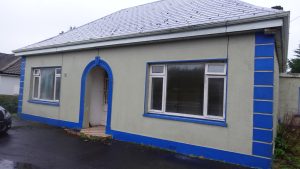
As is often the case with this housing stock, the property has since undergone a significant renovation. An additional floor was added, a rear extension, along with multiple upgrades to the building fabric and services. Architectural drawings were prepared, and the post-works Building Energy Rating is now complete. It achieved a high A2 rating.
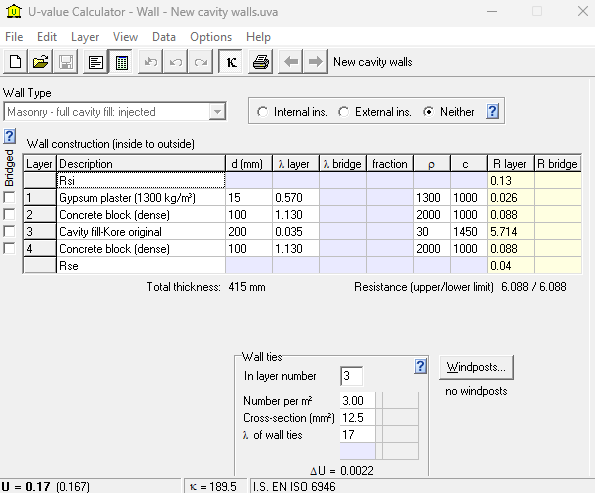
Once this level of information is available, and once the works move beyond simple upgrades, non-default values must be used in line with SEAI guidance. There is no middle ground. A U-value cannot be partly default and partly calculated. Once a non-default approach is required, the element must be calculated fully and accurately from inside to outside, reflecting the actual construction. This project involved the calculation of twelve non default U values in total, one for the floor, four for the walls and seven for the various types of roofs. The BRE U-Value Calculator is one of the most widely used tools by BER assessors for carrying out these calculations.
While non-default fabric inputs may not always move the headline BER as dramatically as adding a heat pump or solar PV, they are essential. U-value targets must be demonstrated as being met. The purpose of this work is to verify that the dwelling performs in line with the design intent.
That verification may not be obvious on the BER certificate itself, but it is clearly demonstrated in the dwelling energy assessment procedure (DEAP) dwelling report and by the supporting U-value calculations and documentation. This allows architects and engineers to confirm that the specifications they set at design stage have been achieved on site.
With the addition of a new floor, the assessment changes fundamentally. The intermediate floor itself is no longer a heat-loss element. However, new ceilings are introduced, and these ceilings now form part of the heat-loss envelope of the dwelling.
Where non-default inputs are required, floor and ceiling U-values must be calculated rather than relying on default values. This involves perimeter-based calculations, insulation thicknesses, and verified thermal conductivities. Where available, screed depth is also included. Each input must be supported and clearly understood before a non-default value can be applied.
Roofs
In this dwelling, the roof construction was one of the most complex aspects of the BER. There were multiple roof build-ups, each requiring its own non-default U-value calculation.
A U-value represents the thermal performance of the entire construction, not just the insulation. Every material layer, along with internal and external surface resistances, must be accounted for.
Even where an architect provides a very good as-built drawing, key information can still be missing. This is not a criticism, architectural drawings are not typically produced for the purpose of U-value calculation. As a result, clarification is often required to confirm material layers, ventilation conditions, and airtightness lines.
Walls and complex construction
Wall calculations depend on whether the element relates to the original dwelling or to new construction.
Existing walls may be upgraded through additional insulation, allowing default U-values to be improved where sufficient evidence is available. New wall elements associated with extensions or additional storeys are treated as new construction and calculated using recognised U-value calculation methods.
For example, in this dwelling, the new cavity walls were fully filled with bead insulation to a verified thickness of 200 mm. This required confirmation through as-built documentation before non-default values could be applied.
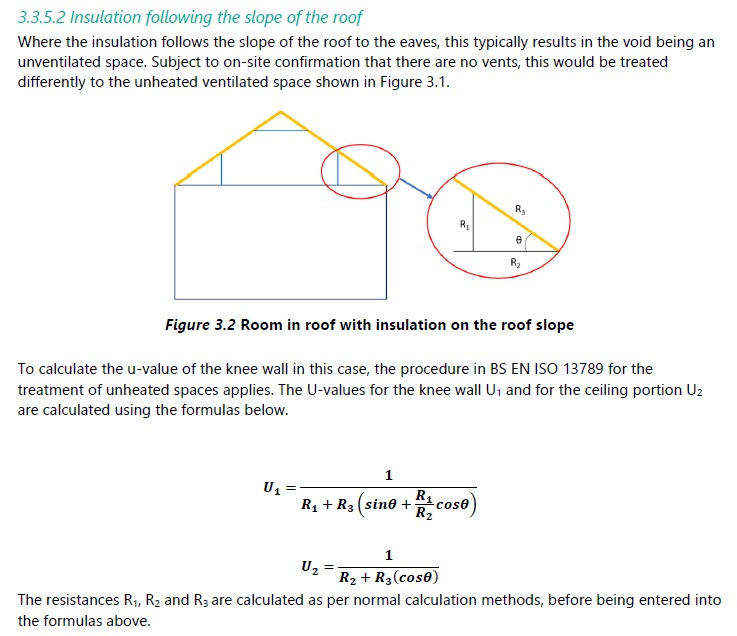
A particularly complex scenario arises in dormer dwellings where the airtightness line runs up the external wall and continues along the sloped rafters. This creates an unventilated warm space behind the knee wall. In this case, heat loss occurs primarily through the sloped roof rather than the inner wall itself. The knee wall therefore does not generally require insulation, or may only require minimal insulation, as the insulation and airtightness strategy is working at rafter level.
This is a common modern roof detail. Where insulation follows the roof slope to the eaves, the knee wall and ceiling must be treated using a specific methodology set out in the DEAP guidance. This involves resolving the geometry of the space and calculating multiple interacting thermal resistances. It is a level of technical modelling that goes well beyond standard inputs and requires both experience and careful interpretation of the guidance to ensure accuracy.
Windows and doors
Windows and doors are another area where complex BERs differ significantly from straightforward assessments.
To enter non-default values, certification must be provided by the supplier and clearly linked to the dwelling. For doors, this typically requires a cover letter referencing the relevant certificate numbers and address.
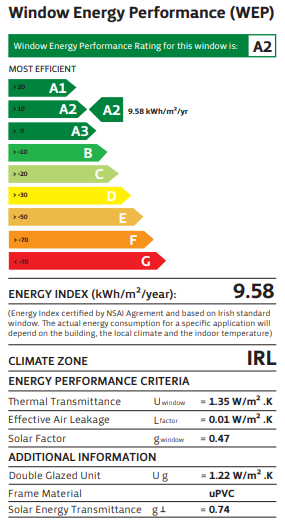
Windows often require multiple certificates, standard casement windows, sliding doors, patio doors, sidelights, roof windows, and bespoke glazing systems may all differ. The key inputs are the U-value and the solar transmittance, which must be expressed as g⊥ (G-perpendicular). Where certificates are unclear, or where g-window values are provided instead, clarification is required.
In some cases, individual windows have individual U-values, requiring dimensions to be matched against supplier reports on a window-by-window basis. This can take significant time and often involves further communication with suppliers. Providing guidance to suppliers can help standardise certification and reduce delays on future projects.
Thermal mass and thermal bridging
For complex BERs, non-default thermal mass can be calculated by measuring thermally heavy and thermally medium elements such as walls and floors, and in some cases ceilings where hollow-core construction is present. These areas are totalled and normalised by the floor area to determine the thermal mass category.
Thermal bridging is also a key consideration. For most renovation projects, the default thermal bridging factor applies. Improved values may be used in new builds where acceptable construction details are available and signed off, or where thermal bridges are calculated directly. Where evidence is incomplete, default values must be used.
Ventilation and airtightness
Ventilation inputs can include intermittent extract fans, cooker hoods, and the presence of a draft lobby where designed.
A non-default air permeability value can only be entered where an airtightness test has been carried out. In the absence of a test, a conservative default value must be used, which can significantly under-represent the performance of a well-executed retrofit.
Ventilation systems are entered based on the selected strategy, such as balanced mechanical ventilation with heat recovery, mechanical extract ventilation, positive input ventilation, or natural ventilation. System efficiencies and fan powers are sourced from the Appendix Q – Product Characteristics Database.
Semi-rigid duct systems listed in the Appendix Q – Product Characteristics Database have demonstrated aerodynamic performance, when installed in various configurations, that is at least equivalent to rigid ducting. Where such systems are used with balanced mechanical ventilation with heat recovery (MVHR), they may be treated as equivalent to rigid ducting for the purposes of DEAP assessments, provided the installation aligns with the certified configuration.
However, where the duct type referenced in the PCDB performance data for a balanced system does not match the duct type installed in the dwelling, default values must be applied in DEAP.
For mechanical extract ventilation systems, semi-rigid ducting may not be considered equivalent to rigid ducting, even if listed in the PCDB, unless the specific unit certification clearly states a “semi-rigid” layout or duct type.
Space and water heating
Space and water heating inputs include the heating system type, emitters, controls, pumps, and the heat source itself.
For heat pumps, non-default values require the eco-design data sheet and the SEAI Designer / Installer Sign-Off. While most information is available on eco-design data sheets, some inputs may be missing or described differently to DEAP methodology. An example is the volume of hot water accounted for in test conditions, which is derived from test data and does not have a default available.
For most other inputs, defaults exist, but the use of any default will reduce the calculated efficiency. This can put SEAI technical standards at risk, such as minimum efficiency requirements for space and water heating. For this reason, defaults should be avoided wherever possible.
Flow temperatures are taken from the designer documentation and heating design sheets. These must be checked carefully. Where inconsistencies or errors are identified, default flow temperatures must be used, which can result in further communication with designers and contractors and delays to BER publication. Radiator data sheets and conversion factors are a common source of error and must be verified by the BER Assessor to support lower flow temperatures.
Lighting and renewables
Lighting is typically assessed based on the proportion of LED, CFL, halogen, and incandescent fittings, as full lighting designs are rarely available.
Renewables, most commonly solar PV, require technical data sheets with appropriate certification. Panel watt-peak values are combined with roof orientation and pitch to calculate the annual contribution to the dwelling’s energy demand.
Why this matters
As this example shows, carrying out a complex, non-default BER involves significant work. It requires detailed surveying, extensive documentation review, multiple calculations, professional judgement, and ongoing coordination with designers, contractors, and suppliers.
Importantly, all BERs are subject to SEAI audit, and any errors identified can result in penalty points. Accuracy, supporting evidence, traceability, and defensibility are therefore essential.
A complex BER is not about chasing a better rating. Good headline ratings are often achieved through the installation of heat pumps and solar PV. The real purpose of a complex BER is to produce an accurate, defensible, high-quality assessment that verifies the performance of the dwelling as designed and constructed.
Beyond defaults
Going beyond defaults means validating the design intent after construction, and accurately reflecting the dwelling energy performance, element by element. It means producing a Building Energy Rating that the professionals involved can stand over, one that confirms to architects, engineers, One Stop Shops, contractors, homeowners, and third parties that the dwelling will perform as it was designed to perform.
That is what a complex Building Energy Rating really involves and why doing it properly matters.