
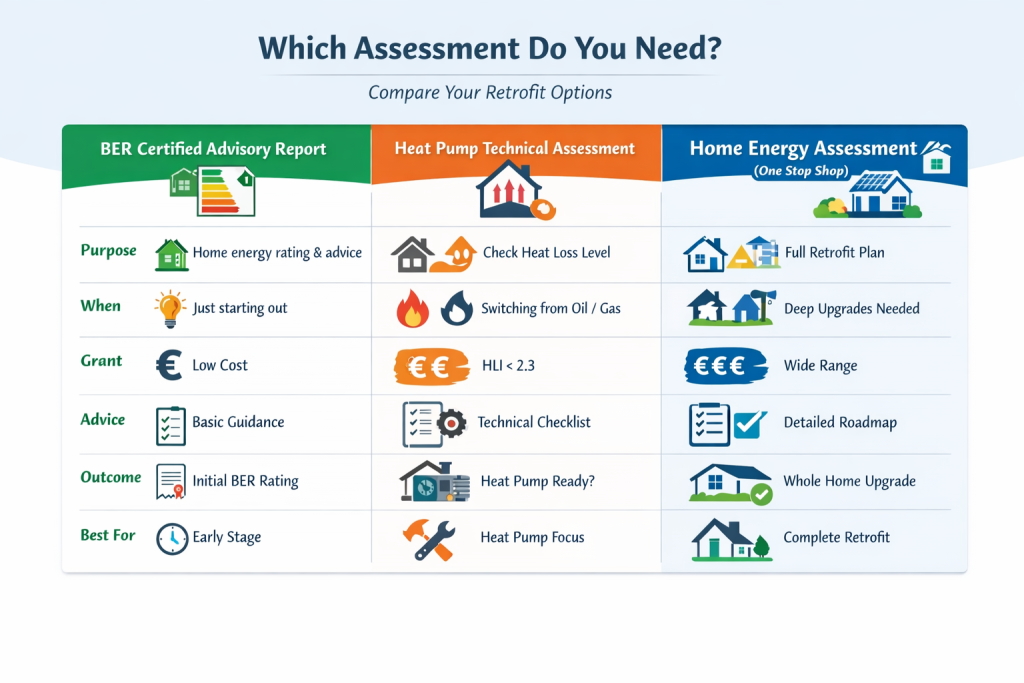
If you’re thinking about retrofitting your home, it’s very common to start with a simple request, “I think I need a BER.”
We hear this all the time and it makes complete sense. But in reality, there are three different services homeowners often ask for at this stage. Choosing the right one early can save confusion, cost, and rework later.
Let’s walk through them clearly.
1. BER Certificate & Advisory Report – The Best Starting Point
A BER Certificate & Advisory Report is often the best first step for homeowners who are considering upgrades but aren’t yet sure how far they want to go.
A BER assessment:
- Includes a full survey of your home
- Comes with an official advisory report outlining recommended improvements
- Helps you understand how your home currently performs
- Provides a solid professional basis for decision-making
For many homeowners, the real value of a BER is not just the certificate it’s the on-site discussion that follows the survey.
There is a huge amount of information available online, from podcasts and energy shows to social media advice, and it can be overwhelming. Having a professional in your home, immediately after the survey, allows you to ask questions in context and get clear, practical answers.
Homeowners leave that conversation with confidence instead of confusion, and with a much clearer sense of what makes sense for their house.
2. Heat Pump Technical Assessment – A Targeted but Limited Tool
A very common trigger for retrofit is an aging oil or gas boiler. Rather than investing in another fossil-fuel system that could lock them in for the next 15–20 years, many homeowners begin to explore heat pump systems.
To qualify for the heat pump grant through SEAI, your home must meet certain technical requirements. The key one is the Heat Loss Indicator (HLI), which must be: ≤ 2.3 W/m²K
This value comes from a DEAP calculation and reflects how much heat your home loses through its fabric.
Some newer homes (generally post-2007) may already meet this requirement and can opt out of a full Home Energy Assessment. Others require a Heat Pump Technical Assessment.
This assessment:
- Is typically delivered in a structured SEAI Excel template
- Confirms whether the home meets the HLI threshold
- Identifies upgrades required if it does not
- Acts as a technical pathway for grant compliance
Understanding its limitations
While the technical assessment is a useful compliance document, it does have limitations:
- It is highly technical, containing figures, calculations, U-values, and thermal data
- There is little explanatory narrative within the form
- Homeowners who are unfamiliar with construction terminology may find it confusing
- Even some contractors may struggle if they are not used to interpreting thermal performance data
In short, it tells you what must be achieved, but not always why, how, or in what broader context. It also does not allow much room for discussion, prioritisation, or tailoring based on homeowner goals.
3. Home Energy Assessment (One Stop Shop) – The Whole-House Approach
One of the challenges with focusing only on the heat pump grant is that many homes need fabric upgrades first:
- Insulation
- Windows and doors
- Ventilation
- Airtightness
Without these, a heat pump may not perform efficiently or comfortably.
This is where a Home Energy Assessment (HEA) through a One Stop Shop can be a better route.
The One Stop Shop approach is designed for deep, whole-house retrofits and provides access to a much wider range of grants, including:
- Heat pump system and central heating system
- €2,000 heat pump bonus (currently available)
- Heating controls
- Solar hot water
- Attic and rafter insulation
- Cavity, internal, or external wall insulation
(note: only one wall insulation grant can be claimed) - Windows and doors
- Floor insulation
- Solar PV panels
- Mechanical ventilation
- Airtightness works
- €350 grant towards the Home Energy Assessment
- Project management grant
When combined, these grants can add up to a very significant total, often far more than organising upgrades individually.
Why the Home Energy Assessment Often Offers Better Value
When homeowners contact us looking only for a heat pump technical assessment, we often suggest that they at least speak to a One Stop Shop and consider a Home Energy Assessment, even if they do not plan to proceed through that route.
The reason is simple:
A Home Energy Assessment report is far more comprehensive.
It typically includes:
- A full overview of the home’s energy performance
- A step-by-step upgrade roadmap
- Ballpark cost ranges
- Clear explanations, not just figures
- Advice shaped by discussion with the homeowner
From a cost point of view:
- The HEA grant is €350, deducted upfront from the cost of the HEA
- The heat pump technical assessment grant is €200, but must be paid upfront and only refunded if the heat pump is installed.
In practice, the difference in upfront cost is relatively small, but the difference in clarity, depth, and long-term value is substantial.
For homeowners who are genuinely serious about retrofitting their home properly, the Home Energy Assessment often delivers far better overall value.
So, Which One Do You Need?
- Not sure yet?
→ Start with a BER Certified Advisory Report - Focused only on installing a heat pump?
→ A Heat Pump Technical Assessment may be appropriate - Planning a deeper retrofit or weighing multiple options?
→ A Home Energy Assessment via One Stop Shop may be the best option.
Book a Short Call
If you’re unsure, that’s completely normal. A short conversation with us can usually clarify the best path forward and help you avoid costly mistakes later.